Mercury can be an elusive planet, it is not very bright and is always near to the Sun so in twilight. It can also be dangerous to look for if you have not let the Sun set. However for those that have never seen it now is your chance. This evening (22 May) it will be very close to Venus, which is really easily to spot as twilight falls in the north west. At 10pm BST Venus will be on an azimuth of around 298 degrees and at altitude from the horizon in Abergavenny of around 10 degrees, so pretty low. Mercury will be very close by to Venus’ left side (east). It has a good chance of being clear so why not go out and have a look. Maybe a good photo opportunity.
Category: News
Latest news about the Society
Planet 9 – What are you? (PhysicsWorld 19th May)
Pluto may have been demoted from planet status back in 2006 but astronomers are still trying to explain the orbits of a number of other Kuiper Belt objects which are in highly elliptical orbits.
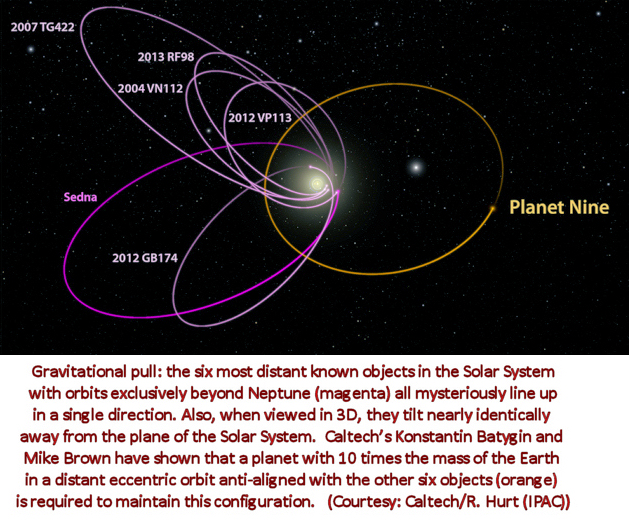
Whilst searches for a conventional “Planet Nine” have proved unsuccessful so far a report in Physics World, dated 19th May, ( Link ) looks at the proposal by Edwar Witten, Princeton, to evaluate the suggestion, first made in 2019 by Scholtz, Durham, and Unwin, Chicago, that a small black hole, around 10 times the mass of the Earth, could be stabilising these orbits. This is very small, a black hole the mass of the sun only has a radius of around 3 km (the Schwarzschild radius), the distance from Abergavenny to Govilon.
Witten’s proposal is to launch a fleet of lightweight probes, 100g, in the direction of the presumed Black Hole. To quote the article “His proposal is a more modest version of the Breakthrough Starshot project ( Link ) which aims to send ultra-light probes on a 20 year journey to the nearby star Alpha Centauri using an Earth bound laser array”. Witten’s proposal would involve a 10 year journey to 500 AU, well beyond the Kuiper Belt, which is thought to extend to 50 AU and towards the hypothetical Oort Cloud which may start at 2,000 AU.
However, Witten does qualify his proposal, “It is far from clear that this approach is practical…”
Mike Brown, Caltech, a Planet 9 searcher says “We’re still looking hard. If we don’t find Planet Nine in any of the dedicated searches, I suspect it will turn up pretty quickly in LSST [the Large Synoptic Survey Telescope”. Read Brown’s Planet 9 hypothesis at ( Link )
The Galilean Moons
Worried about Corona Virus? Desperate for a summer holiday? Looking for somewhere off the beaten track, not over-run by tourists and Corona free?
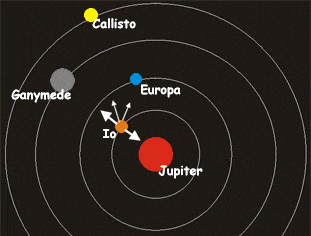
An article on the Astrobites website looks at the possibility of the Galilean moons as potential possibilities.
I have posted the astrobites article on the “general Items” page ( HERE ) and the address for the actual article is HERE, but in summary the best bet looks like Callisto.
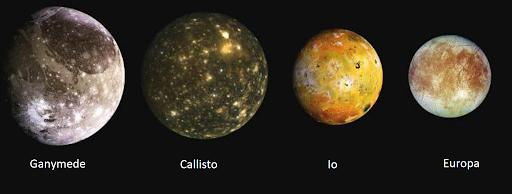
Io : the closest to Jupiter, is the most geologically active of the moons due to the tidal forces from the planet. There are strong enough to cause solid tides where the the surface bulges 100m or so a day. It is also a bit close for the radiation from Jupiter, some 4.5 million times that on earth.
Europa : Although not covered by the astrobites article Europa doesn’t really appeal as a holiday destination. Like our moon one side is always facing Jupiter. It is the smallest of the 4 moons and is comprised of a smooth surface, thought to be ice, overlying an ocean with a iron core. It is the smallest, thus the lowest gravity, subject to strong tidal forces and prone to the eruption of water spouts over 100 miles high and high radiation from Jupiter.
Ganymede : It does have an internal magnetic field, but only a small fraction of the Earth’s, so radiation is definitely still a problem and you would have to stay under ground. Shame really as the sight of Jupiter in the sky, 36 times larger than our moon and amazing aurora, must be something to behold.
Callisto : the furthest of the Galilean moons for Jupiter. This results in a radiation level only 12 times that on Earth, probably fine for a 2 week holiday. There is also plenty of water on the moon so showers and hand washing should be OK.
The other downside is, of course, getting there. No charter flights at the moment and it did take NASA’s Juno probe 5 years to get there!
Going globular!
It goes without saying that for the time being our regular meetings are cancelled but that is no reason to stop stargazing. Spring is the time for amateurs to observe galaxies, as they are particularly well placed in the southern sky at this time of year. However galaxies do need a bit of experience to find and a telescope with a reasonably large aperture. On the other hand the globular clusters are just coming into their own and can be found with the most basic of binoculars. If you are fortunate enough to own a telescope they are truly marvellous. Globular clusters are possibly the most mysterious and enigmatic denizens of our galaxy. Because they are reasonably bright they can found quite easily even with some light pollution. The document below explains how you can find 5 of the best globular clusters. It should also help you to get started on “star-hopping” – using various star patterns and asterisms to locate objects in the sky that you cannot see by eye alone. If you have no optical aids at all it will help you to learn the constellations of the spring sky. So next time it is clear get out in the garden or even out of a window and try to find yourself a globular cluster.
[Download not found]Starlink satellite train
Some members may have seen a string of satellites over South Wales last night at around 9:22 BST. it was of course the satellite train of Starlink. It should be clear tonight and there is another opportunity to see it at 9:58 this evening (20th April 2020). It will last for 6 minutes, the train traveling from west to east. There is another opportunity tomorrow evening at 10:34 pm and on the 22nd at 9:34pm. The satellite are controversial as many astronomers feel that they will interfere with observing. They certainly will interfere with astrophotography, as existing satellites and aircraft do. It remains to be seen how much of a problem they present.
Starting stargazing
We have recently had a patch of dry sunny weather with clear skies, let’s hope it continues. If you want to do a bit of stargazing but really do not quite know where to start you may find the following document helpful. It is not for the experienced observer but for those that feel like having a quick go from the back garden and to give them a start. So now you have no excuses, loads of spare time and simple instructions, no equipment needed (binoculars are a bonus) – so what are you waiting for? Happy stargazing and stay safe and healthy by not going out (other than the back garden!)
[Download not found]