Feb 2021 – Mars Month?

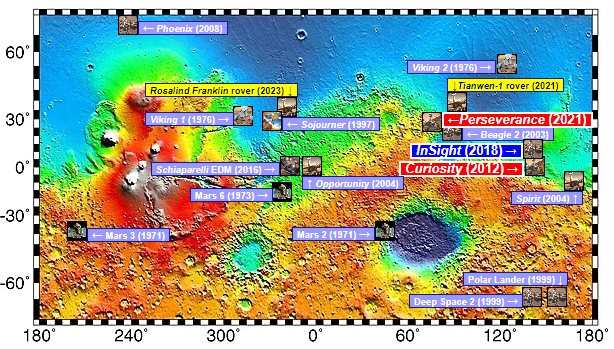
Map of the global topology of Mars overlaid with locations of landers and rovers

18th February:  Nasa has managed to crane their rover and helicopter into the Jezero Crater on Mars.  It’s now about 2km from what is thought to be an ancient (that’s 4 billion years ago!) river delta that fed a huge lake.  Jezero is a small town in Bosnia with a population of 1100, Jezero means lake in a number of Slavic languages.  This crater was named in 2007 by the IAU as part of a project to name significant craters after small towns and villages in the world.
Now we await the testing of Perseverance and Ingenuity’s’ systems and for the science data to start to come back.

Mars2020 now joins the two other visitors to Mars this month:-
1)   On the 9th February the successful mission by the UAE to put the Al Amal (Hope) Probe into orbit to study the Martian atmosphere amongst other objectives.  This makes the UAE the 5th country to reach Mars and the second to enter orbit on it’s first try;  and
2)   Followed on the 10th February by the successful insertion of Chinas’ first mission to Mars, Tianwen-1, into orbit.   It also carries a rover that is scheduled to land in May or June.  The Tianwen-1 rover includes a ground penetrating radar that can “see” up to 100m below the surface.

Emirates Mars Mission – LINK     :     Tianwen-1 – LINK     :     Mars2020 – LINK

Stargazing activity for this week

Additional note, I did this exercise for Abergavenny last week and although it was not the best of nights – it was a bit misty and very cold, I managed to count 14 stars in Orion from my back garden in Abergavenny.  The app then informed me that that was better than 77% of places in the UK so that can’t be bad. – Nick Busby


Not sure if it will be clear at all this week but if it is there is an activity going on that the Campaign for Rural England organises each year.  The idea is that you count all the stars you can see by eye in the constellation of Orion and send in the results.  This will allow any changes to light pollution in the UK to be mapped.  You can find full details and all support materials by clicking on the following link:

Star Count 2021: explore what we learned


Something for Feb – Perseverance Rover due at Mars

There is a lot of interest in Mars at the moment from a number of different countries with current missions from China and the UAE and plans by the ESA/Russia, Japan and India in the next 3 or 4 years.

First up look out on the 18th February for the scheduled landing of the NASA Mars Perseverance Rover, if successful it will be another engineering feat using a “sky crane”.

Mars Perseverance Rover landing Feb 2021

It includes another engineering first, Ingenuity, the first helicopter to operate outside of the Earth.  This is a test to check the feasibility of flying a drone on a planet with a much thinner atmosphere, 1% of the thickness of Earth’s atmosphere.  It weights 1.8kg and is fitted with counter rotating blades running at 2,400rpm.

Mars Perseverance Rover-Ingenuity Drone

Further info:-
Perseverance Mission  :  Ingenuity Helicopter  :  Wikipedia page-missions to Mars

Happy New Year

Wishing you a very happy, peaceful and healthy New Year.

It has certainly been a difficult and challenging year to put it mildly.  Out of necessity we have become used to staying in touch via Zoom but can look forward with hope that at some point this year we will be able to meet again in person. 

On a more positive note and setting aside for a moment the problems that 2000 held, from an astronomical observers viewpoint it was a remarkable year, particularly for those with an interest in our solar system.  Jupiter and Saturn were around for much of the summer although annoyingly low in the sky, but they made up for that with the best conjunction since 1623 on 2000 December 21.  The 1623 conjunction was not visible at night – you would need to go back to 1226 to have seen the next best one and you will not be able to see a similar conjunction until 2080.  The planets also made a spectacular triple with a crescent Moon on the December 16th.

Still on the planets, Mars has had one of its best apparitions in many years.  It was very close and large and thankfully, unlike the last apparition a couple of years ago was not veiled by sandstorms.  It is still observable high in the south west early in the evening although is much smaller and receding rapidly.

In July, literally out of the blue, we had the comet C/2020 F3 (NEOWISE).  This comet was first spotted back in late March during the NEOWISE mission of the Wide-field Infrared Survey Explorer (WISE) space telescope.  Nobody knew then what a beautiful naked eye object it would turn out to be.  It was easily visible at dusk in the northern skies for a couple of weeks.

All of these phenomena could easily be observed by eye and even photographed with basic equipment, which goes to show that you do not need to go to any expense to enjoy the night sky, it can be a very welcome source of joy and diversion from more earthly problems whatever one’s means.


Comments:-

Its been about 10 months since I took up astronomy and being a member of AAS (at least in theory as I didn’t quite make my first meeting before lockdown kicked in early 2020) has helped enormously.
Particularly a big thank you to Nick Busby who has helped me enormously with both setting up my telescope and tips and advice- I have enjoyed the Zoom meetings very much – very informative and interesting thanks to all who gave presentations.
I am looking forward to this new year and observing the night sky, as well as doing a bit of astrophotography – will be great when we can get together for real , have a pint and meet some of you!
Clear skies and thank you!!!
Tony P-F